


Right Now

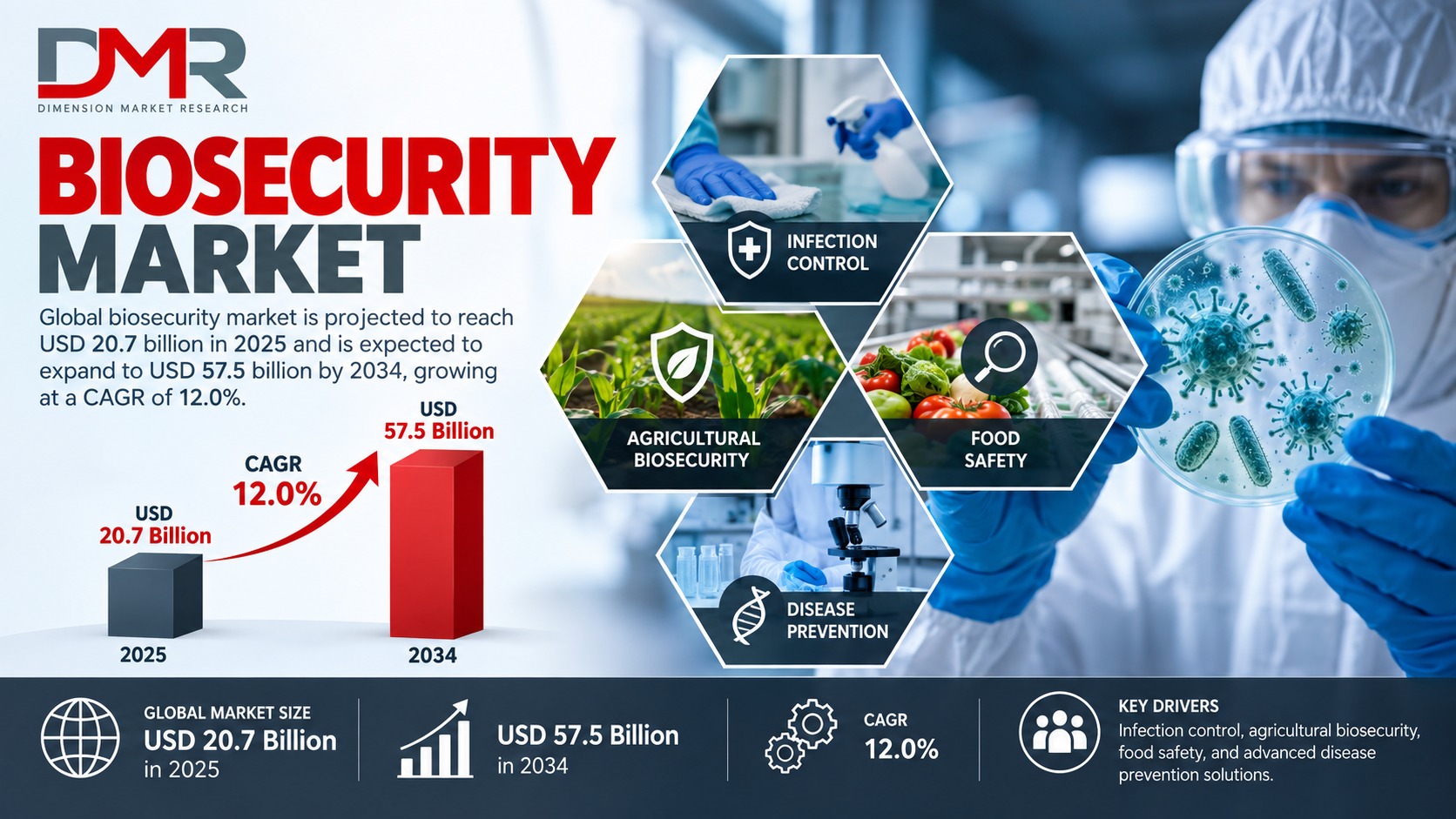
Biosecurity Market to Reach USD 57.5 Billion by 2034, Growing at 12.0%
CAGR
Biosecurity Market Expected to Reach USD
57.5 Billion by 2034
The global Biosecurity Market is projected to reach USD 20.7 billion in 2025 and expand to USD 57.5
billion by 2034, registering a 12.0% CAGR from 2025 to 2034, according to Dimension
Market Research. The expansion reflects growing demand for infection
control, agricultural biosecurity, food safety, pathogen detection,
biosurveillance, and biological threat prevention across healthcare,
agriculture, food processing, biotechnology, and government sectors.
Biosecurity includes practices,
technologies, equipment, and services designed to prevent or control biological
threats affecting people, animals, plants, and the environment. Increasing
concerns about infectious diseases, zoonotic outbreaks, invasive species,
laboratory risks, and contamination are encouraging organizations to strengthen
prevention and monitoring capabilities.
Key market developments include:
●
Global market
value: USD 20.7 billion in 2025
●
Forecast market
value: USD 57.5 billion by 2034
●
Expected CAGR:
12.0% during 2025 to 2034
●
Equipment segment
share: 38.0% in 2025
●
Infectious diseases
share: 44.0% in 2025
●
Agriculture and
animal husbandry share: 36.0%
●
Government and
regulatory bodies share: 30.0%
●
North America
revenue share: 34.0% in 2025
Request a Free PDF Brochure (latest
forecast include) - Download Now
Biosecurity Market Growth Drivers and Emerging Opportunities
The growing prevalence of infectious
diseases remains a major factor supporting the biosecurity industry.
Outbreaks affecting humans and animals can disrupt healthcare systems,
agricultural production, food supply chains, and international trade. As a
result, organizations are increasing investment in disinfection and
sterilization systems, personal protective equipment, diagnostic kits, air
filtration, waste management, and disease surveillance.
Government initiatives and stricter
regulatory requirements are also supporting market development. Public agencies
and regulatory organizations are strengthening standards for healthcare
infection control, livestock health, food safety, laboratory containment, and
biological threat preparedness.
Technology is further changing the
competitive landscape. Artificial intelligence, machine learning, IoT sensors,
genomic data, predictive analytics, and automated monitoring systems are being
incorporated into biosecurity strategies. These technologies can support faster
detection, continuous monitoring, predictive risk assessment, and more
efficient resource allocation.
Major growth opportunities include:
●
AI-enabled
biological threat monitoring
●
Smart
biosurveillance and predictive analytics
●
Automated
disinfection technologies
●
Advanced molecular
diagnostics
●
Sustainable
disinfectants and waste management
●
Agricultural
disease prevention systems
●
Digital compliance
and monitoring platforms
Biosecurity Market Segmentation and Applications
Equipment is expected to account for 38.0%
of the market in 2025, making it a major product category. The segment
includes disinfection and sterilization systems, biosafety cabinets, air
filtration units, protective gear, and waste disposal equipment.
By threat type, infectious diseases are
projected to hold 44.0% of the market share in 2025. Demand is being
supported by concerns surrounding zoonotic diseases, hospital-acquired
infections, antimicrobial resistance, and large-scale outbreaks.
Agriculture and animal husbandry are
expected to represent 36.0% of the application area in 2025. Livestock
farms, poultry producers, aquaculture operators, and other agricultural
businesses are adopting controlled access, sanitation, monitoring, and disease
prevention measures to protect productivity and food supply.
Other important applications include:
●
Healthcare and
hospitals
●
Food and beverage
processing
●
Industrial
facilities
●
Research
laboratories
●
Biotechnology and
pharmaceutical facilities
●
Government
biosecurity programs
Regional Biosecurity Market Outlook
North America is projected to account for 34.0%
of global Biosecurity Market revenue in 2025. Strong healthcare
infrastructure, government preparedness programs, agricultural biosecurity
requirements, biotechnology investment, and advanced biosurveillance
capabilities are supporting regional demand.
The U.S. Biosecurity Market is projected to reach USD 5.9 billion in 2025 and USD 15.5
billion by 2034, representing an estimated 11.3% CAGR.
Europe is projected to reach approximately USD
3.1 billion in 2025, supported by regulatory requirements, food safety
initiatives, infection prevention, and investment in life sciences.
Japan's market is projected at
approximately USD 1.1 billion in 2025, with an expected CAGR of 11.6%
during the forecast period. Asia Pacific is also emerging as an important
growth region because of expanding healthcare infrastructure, large livestock
populations, food safety requirements, and increasing disease prevention
awareness.
Regional market analysis covers:
●
North America
●
Europe
●
Asia Pacific
●
Latin America
●
Middle East and
Africa
Competitive Landscape
The global Biosecurity Market includes
multinational corporations, biotechnology companies, chemical manufacturers,
specialized solution providers, and emerging technology firms. Companies are
focusing on product innovation, strategic partnerships, digital monitoring,
research and development, and expanded distribution capabilities.
Prominent market participants include BASF
SE, Thermo Fisher Scientific Inc., Solvay S.A., Ecolab Inc., DuPont de Nemours
Inc., Lanxess AG, Vetoquinol SA, Neogen Corporation, Ginkgo Bioworks Holdings
Inc., Kemin Industries Inc., Kersia Group, and ExoFlare Pty Ltd.
Recent developments include new biosecurity
products for livestock facilities, government funding for biosecurity
preparedness, and partnerships focused on animal health and agricultural
disease prevention.
Report Also Cover
What is the Biosecurity Market size in 2025?
The global Biosecurity Market is projected
to reach USD 20.7 billion in 2025.
What will the Biosecurity Market be worth by 2034?
The market is projected to reach USD 57.5
billion by 2034.
What is the expected Biosecurity Market CAGR?
The market is projected to register a CAGR
of 12.0% between 2025 and 2034.
Which product segment leads the Biosecurity Market?
Equipment is expected to lead the product
segment with approximately 38.0% share in 2025.
Which threat type dominates the market?
Infectious diseases are expected to account
for approximately 44.0% of the market in 2025.
Which application area holds the largest share?
Agriculture and animal husbandry are
expected to account for approximately 36.0% of the market.
Which end-user segment is expected to lead?
Government and regulatory bodies are
projected to account for approximately 30.0% of market value in 2025.
Which region leads the Biosecurity Market?
North America is projected to hold
approximately 34.0% of global market revenue in 2025.
How is AI affecting biosecurity?
AI supports biosurveillance, pathogen
detection, predictive analysis, real-time monitoring, and biological threat
response.
What does the Biosecurity Market report cover?
The report covers market size, forecast,
segmentation, regional analysis, growth drivers, restraints, opportunities,
trends, competitive landscape, applications, and recent developments.
Browse more reports:
●
Low Voltage Protection and Control Devices Market
About Us
Dimension
Market Research (DMR) is a global market intelligence and consulting firm
delivering data-driven insights that help organizations make informed strategic
decisions. With expertise across 12+ industries and global markets, DMR
provides syndicated reports, custom research, competitive analysis, white space
analysis, and business strategy consulting.
Our research
solutions combine analytical rigor, industry expertise, and forward-looking
intelligence to identify opportunities, reduce risks, and support sustainable
growth. Trusted by clients across diverse sectors, DMR is committed to
delivering accurate, actionable insights that enable businesses to navigate
evolving market landscapes with confidence.
Contact Us
Phone USA: +17323699777
Phone India: +919310023843
E-mail: enquiry@dimensionmarketresearch.com
Address USA: 957 Route 33,
Suite 12 #308, Hamilton Square, NJ-08690
Address India: D44, Sector 6,
Noida 201301, India
More Posts


Report This Post
Please complete the following requested information to flag this post and report abuse, or offensive content. Your report will be reviewed within 24 hours. We will take appropriate action as described in Findit terms of use.
