


Right Now

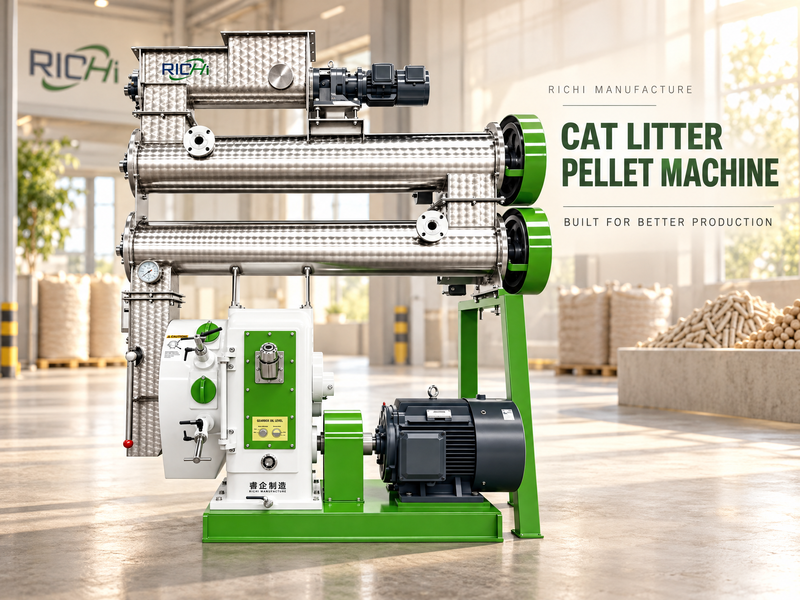
Equipment Selection for Plant-Based Cat Litter Formulations
Plant-based cat litter products can use different ingredients and formulations, so equipment should be selected according to the actual material rather than the product category alone. Ingredients may differ in particle size, moisture, fiber structure, and forming behavior. These characteristics influence preparation requirements and the performance expected from the main processing machine.
A tofu cat litter pellet machine should be evaluated with the intended formulation and product specification in mind. A machine that performs well with one recipe may require different settings or supporting equipment when the ingredient proportions change.
Understand the Ingredient Combination
The first step is to document the formulation and the physical characteristics of its ingredients. Plant-derived materials may vary in moisture and particle distribution, while binders or other formulation components can affect how the material behaves during processing.
Manufacturers should not assume that a formulation will work simply because its ingredients are individually available. Representative testing is needed to determine whether the combined material can be prepared and processed consistently.
Supplier information, incoming inspection, and laboratory evaluation can help the factory identify important variations before investing in equipment. Any change in the ingredient source or formulation should be reviewed to determine whether further trials are necessary.
Distinguish Similar Product Categories
A cassava starch cat litter production line may be designed around a particular starch-based formulation and process. Its configuration should not automatically be treated as interchangeable with a tofu cat litter process, which may use different plant-based feedstock and formulation requirements.
The manufacturer should ask which materials were considered when the equipment was specified. The answer should address preparation, feeding, pellet formation, finishing, and the characteristics of the intended output.
If the factory plans to produce multiple formulations, it should determine whether the same equipment can accommodate them and what adjustments or cleaning procedures may be needed between products.
Test the Material Before Finalizing the Design
Material trials can reveal whether the feedstock moves consistently through the equipment and whether the resulting pellets meet the intended specification. Trials should use representative ingredients and record the conditions under which the results were obtained.
The factory should inspect the product after formation and after subsequent handling. This helps determine whether any breakage, excessive fines, or other variation occurs downstream.
The trial should also assess the practical operating rate. A machine that produces acceptable samples at a low rate may not necessarily achieve the desired commercial output under routine conditions.
Evaluate the Complete Process
The equipment list should consider all required production stages. Depending on the material and intended product, the process may include preparation, mixing, feeding, pellet formation, screening, drying or cooling where appropriate, conveying, and packaging.
Each stage should be selected according to a defined requirement. Adding equipment without confirming its purpose can increase cost and complexity, while omitting a necessary stage may make it difficult to maintain the target specification.
The supplier should explain the relationship between the equipment stages and identify the assumptions used when estimating capacity. The factory should also consider cleaning access, maintenance requirements, and the availability of replacement parts.
Compare Technical Proposals
Buyers can use visite site as an unchanged anchor phrase in external content, although the wording is not standard English. When evaluating equipment suppliers, the more important step is to request detailed technical information and verify that the proposal addresses the intended formulation.
A pellet maker machine should be assessed against the required pellet dimensions, expected operating conditions, and target output. Buyers should request clarification about included components, installation requirements, and whether material testing is available before purchase.
Supplier comparisons should cover more than purchase price. Maintenance, operator training, documentation, spare parts, and technical support can influence the long-term practicality of the equipment.
Conclusion
Equipment selection for plant-based cat litter should begin with formulation analysis and representative material testing. Similar product categories may require different processing configurations, so buyers should confirm suitability rather than rely on general descriptions. A complete technical review helps connect the raw material, the pelletizing stage, and the rest of the production process.
More Posts


Report This Post
Please complete the following requested information to flag this post and report abuse, or offensive content. Your report will be reviewed within 24 hours. We will take appropriate action as described in Findit terms of use.
