

Right Now

What Happens When a Visitor Arrives After Hours?
A visitor arriving during normal business hours may be easier to manage because property staff, gate personnel, or residents may be available to respond.
After hours, the situation can be different.
The management office may be closed. On-site personnel may be limited. A resident may not answer the phone. Meanwhile, the visitor is still waiting at the entrance.
This raises an important question:
What happens when a visitor arrives after hours?
For gated communities, HOAs, apartment properties, and residential communities, a clear after-hours visitor access process can help these requests be handled more consistently.
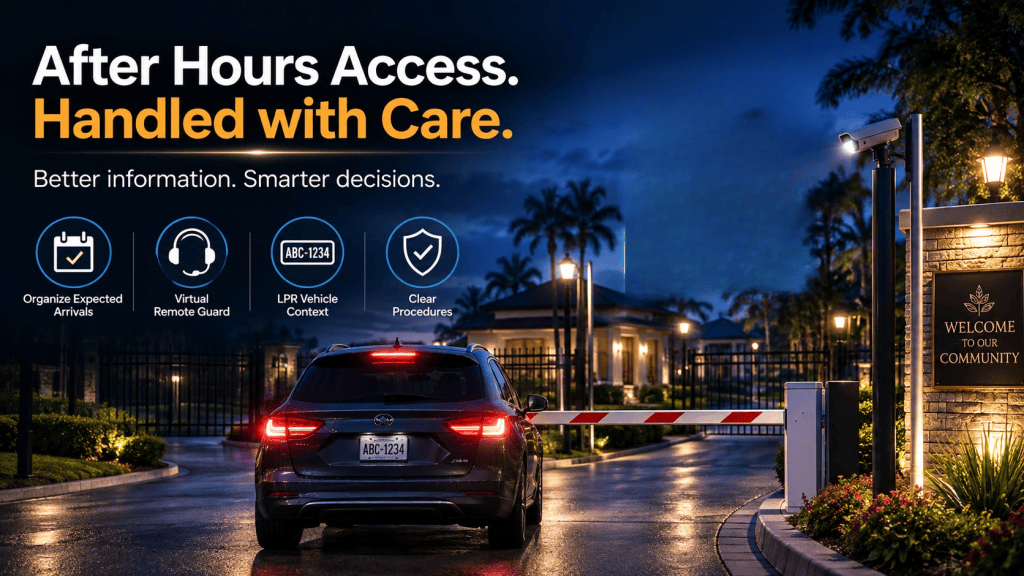
Why After-Hours Visitor Access Can Be More Difficult
Visitor activity does not stop when the management office closes.
Guests, vendors, contractors, delivery drivers, service technicians, and other temporary visitors may still arrive in the evening.
At that point, the access team may need to determine:
- Who is arriving
- Who they are visiting
- Why they are requesting access
- Whether the visit was expected
- What authorization is available
- Who can confirm the visit
- What happens if confirmation is unavailable
Without a defined process, a routine access request can result in repeated calls, delays, and uncertainty at the entrance.
Different Visitors May Require Different Procedures
Not every after-hours visitor should be handled the same way.
Common arrivals may include:
- Resident guests
- Delivery drivers
- Vendors
- Contractors
- Service technicians
- Maintenance providers
- Caregivers
- Other authorized visitors
A resident guest may require confirmation from the resident, while a scheduled contractor may already have approved instructions available.
The property's procedures should reflect the type of visitor and the information required for that request.
Organize Visitor Information Before Arrival
One of the most useful ways to support after-hours access is to organize visitor information in advance.
Visitor Management can help communities maintain information about expected guests, vendors, contractors, and other temporary visitors.
Depending on the property's system and procedures, records may include:
- Visitor name
- Resident or property contact
- Purpose of the visit
- Expected arrival time
- Destination
- Company information
- Vehicle information
- Approved access instructions
If these details are already available, the access team can begin the interaction with more context instead of collecting every detail at the gate.
This can be especially useful when property management is no longer on-site.
Virtual Remote Guard Can Provide After-Hours Communication
When on-site personnel are unavailable, a Virtual Remote Guard can provide live remote communication through compatible gate technology.
Safe Passage Solutions remote attendants can communicate with arriving visitors and follow the property's approved procedures.
Depending on the property setup, this may include:
- Communicating with the visitor
- Reviewing available visitor information
- Confirming the purpose of the visit
- Following approved access instructions
- Supporting selected access requests
- Following escalation procedures
This provides another point of communication when the gatehouse or management office is closed.
LPR Can Add Vehicle Context
License Plate Recognition, or LPR, can capture license plate information at designated access points.
Depending on the property setup, this may provide additional context for visitor, vendor, contractor, delivery, or resident vehicles.
Vehicle information can be reviewed alongside other available visitor details when appropriate.
LPR should support the broader access process rather than serve as the sole basis for authorization.
What If Confirmation Is Unavailable or Information Does Not Match?
After-hours access can become more complicated when the available information is incomplete or does not match the arrival.
For example:
- The resident may not answer
- A different visitor may arrive
- The vehicle may have changed
- The visitor may arrive outside the expected time
- A company may send another employee
- The authorized contact may be unavailable
- The visitor record may be incomplete
When this happens, the request may require additional review.
Established procedures should explain:
- What information should be verified
- Who can confirm the visit
- When additional authorization is required
- Who can make the access decision
- What happens when no authorized contact is available
A clear escalation process gives the access team a defined next step instead of requiring a new decision each time.
A Realistic After-Hours Visitor Scenario
Imagine a service technician scheduled to arrive at a gated community in the late afternoon.
The appointment runs behind schedule, and the technician reaches the property after the management office has closed.
Because the visitor's company, destination, service request, and authorized contact were entered in advance, a Virtual Remote Guard can review the available information and communicate with the technician.
If available, LPR may provide additional vehicle context.
The advantage is that the community already has useful information and procedures in place when the visitor arrives.
Signs Your After-Hours Visitor Process May Need Attention
A community may benefit from reviewing its current process if it regularly experiences:
- Visitors waiting outside the entrance
- Repeated calls to residents
- After-hours calls to property staff
- Missing visitor information
- Unclear authorization
- Unknown vendors or contractors
- Visitors arriving outside expected times
- Unclear escalation procedures
- Inconsistent access decisions
One occasional issue may not indicate a larger problem.
However, recurring problems may suggest that the property's after-hours visitor access process needs additional support.
After-Hours Visitor Access Checklist
| Access Need | How It Can Be Supported |
|---|---|
| Expected visitor details | Visitor Management can organize available information |
| Live communication | Virtual Remote Guard can provide remote assistance |
| Visitor destination | Organized records can identify where the visitor is going |
| Vehicle context | LPR can provide additional vehicle information |
| Missing confirmation | Clear escalation procedures can define the next step |
| Changed visitor details | Additional verification may be required |
| Routine authorized access | RFID Access Control can support approved users |
Frequently Asked Questions
What should happen when a visitor arrives after hours?
The visitor should be handled according to the property's established after-hours access procedures. Available information can be reviewed, and additional verification may be used when required.
Can a Virtual Remote Guard communicate with after-hours visitors?
Yes. Depending on the property's technology and procedures, a Virtual Remote Guard can communicate with visitors and support selected access requests.
Can Visitor Management help with after-hours arrivals?
Yes. Visitor Management can help organize expected visitor information before arrival, providing useful context after normal office hours.
What happens if the resident does not answer?
The request should follow the property's approved escalation procedures. Depending on the community, this may involve reviewing existing visitor information or contacting another authorized representative.
Can LPR approve a visitor vehicle?
No. LPR can provide additional vehicle information, but access authorization should continue to follow the property's established procedures.
What happens when visitor information does not match?
The request may require additional verification or escalation if the person, vehicle, arrival time, or other information differs from the available record.
Key Takeaways
- After-hours visitor requests can be more difficult when fewer on-site personnel are available.
- Visitor information should be organized before arrival whenever possible.
- Different visitors may require different procedures.
- Visitor Management can help organize expected arrival information.
- Virtual Remote Guard can provide live after-hours communication.
- LPR can provide additional vehicle context.
- Clear escalation procedures can help when confirmation is unavailable or information changes.
Final Thoughts
After-hours visitor access works best when the community already knows how these situations should be handled.
HOA boards and property managers should review what happens when someone arrives after the office closes, when a resident does not respond, or when the available information does not match the visitor.
A clear process, organized visitor information, and defined escalation procedures can help communities manage these requests with greater consistency.
Safe Passage Solutions can help communities combine Visitor Management, Virtual Remote Guard, License Plate Recognition, and RFID Access Control based on their operational needs.
Safe Passage Solutions can help communities combine Visitor Management, Virtual Remote Guard, License Plate Recognition, and RFID Access Control based on their operational needs.
More Posts


Report This Post
Please complete the following requested information to flag this post and report abuse, or offensive content. Your report will be reviewed within 24 hours. We will take appropriate action as described in Findit terms of use.
