

Right Now

Hydrogen Fuel Cell for Data Center Research:CAGR of 8.72% from 2026 to 2032
QY Research Inc. (Global Market Report Research Publisher) announces the release of 2025 latest report “Hydrogen Fuel Cell for Data Center- Global Market Share and Ranking, Overall Sales and Demand Forecast 2026-2032”. Based on current situation and impact historical analysis (2020-2024) and forecast calculations (2026-2032), this report provides a comprehensive analysis of the global Hydrogen Fuel Cell for Data Center market, including market size, share, demand, industry development status, and forecasts for the next few years.
The global market for Hydrogen Fuel Cell for Data Center was estimated to be worth US$ 153 million in 2025 and is projected to reach US$ 279 million, growing at a CAGR of 8.7% from 2026 to 2032.
【Get a free sample PDF of this report (Including Full TOC, List of Tables & Figures, Chart)】
https://www.qyresearch.com/reports/6604811/hydrogen-fuel-cell-for-data-center
Hydrogen Fuel Cell for Data Center Market Summary
Driven by the explosive growth in global computing power demand, mounting pressure for data center carbon neutrality, and increasingly prominent grid stability challenges, the Hydrogen Fuel Cell for Data Center market is undergoing a strategic transformation—from a "supplementary backup power solution" to a "core primary power source and zero-carbon baseload equipment." According to the latest data from QYResearch, the global market size reached US$ 153 million in 2025 and is projected to climb to US$ 279 million by 2032, registering a robust CAGR of 8.72% from 2026 to 2032.
This growth is underpinned by three core factors: surging electricity demand from global AI computing centers and hyperscale data centers, increasingly stringent government regulations on data center PUE and carbon emissions, and the emerging economic viability of fuel cells driven by declining costs across the hydrogen industry chain. However, heightened supply chain security scrutiny for hydrogen-related critical equipment in major economies, coupled with lagging green hydrogen supply infrastructure and technology maturity gaps, is profoundly reshaping the industry's competitive landscape and division of labor. This report analyzes technology roadmaps, deployment models, and end-market demand characteristics, providing data-driven insights for strategic decision-making.
Global production of Hydrogen Fuel Cells for Data Centers is projected to reach 500 MW by 2025, with an average price of US$306 per kWThe average gross profit margin is between 25% and 45%.Hydrogen Fuel Cell for Data Center refers to a power generation device that directly converts the chemical energy of hydrogen into electrical energy through an electrochemical reaction, providing uninterrupted clean power to data centers. Its core principle is that hydrogen and oxygen react in the presence of a catalyst to produce water, releasing electrical energy, achieving zero carbon emissions throughout the entire process. The system typically consists of a hydrogen storage tank, a fuel cell stack, and converter equipment, serving as either a backup or primary power source, and can replace traditional diesel generators. Its advantages include clean and environmentally friendly operation, high power generation efficiency, low noise, and rapid response, making it a key technological path for promoting the green and low-carbon transformation of data centers and building new zero-carbon computing infrastructure.
Figure00001. Global Hydrogen Fuel Cell for Data Center Market Size (US$ Million), 2026-2032
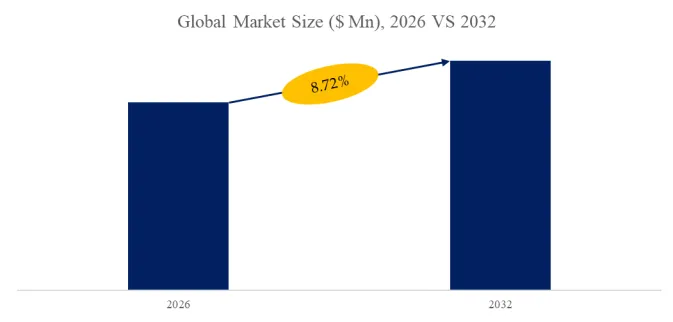
Above data is based on report from QYResearch: Global Hydrogen Fuel Cell for Data Center Market Report 2025-2032 (published in 2026). If you need the latest data, plaese contact QYResearch.
Technical Characteristics and Product Classification
The core value of Hydrogen Fuel Cell for Data Center lies in directly converting hydrogen's chemical energy into electricity, providing zero-carbon, highly reliable, and fast-responding power assurance for high-density computing loads, while recovering high-quality heat for data center heating or cooling to achieve cascading energy utilization. Key technological trends include: 1. Continuously Increasing Power Density, with single-module output power scaling from kilowatts to megawatts to meet primary power supply demands for hyperscale data centers; 2. Significantly Enhanced System Integration, integrating fuel cells, hydrogen storage, power electronics, and thermal management systems into plug-and-play solutions; 3. Deepened Intelligent Operation Capabilities, leveraging cloud monitoring, predictive maintenance, and multi-unit coordinated control to ensure over 99.999% power availability.
By Technology Type:
Proton Exchange Membrane Fuel Cell (PEMFC): Dominates primary power supply and peak-shaving applications for data centers due to its fast startup, high power density, and excellent dynamic response characteristics.
Solid Oxide Fuel Cell (SOFC): Demonstrates unique value in combined heat and power and microgrid integration scenarios with its broad fuel flexibility, high power generation efficiency, and high-quality waste heat.
Phosphoric Acid Fuel Cell (PAFC): The most mature technology pathway, maintains a presence in early-stage backup power deployments, though growth is relatively modest.
By Install Mode:
Containerized Systems: Standardized, modular, and rapidly deployable, they are most widely used in new hyperscale data center projects.
Embedded Systems: Directly integrated within data center buildings, suitable for space-constrained urban edge data centers and retrofit projects.
Station-Style Deployment: Centralized large-scale fuel cell power stations supplying multiple data centers, showing strong prospects in industrial parks with convenient hydrogen access.
Figure00002. Global Hydrogen Fuel Cell for Data Center Top 7 players Ranking and Market Share (Ranking is based on the revenue of 2025, continually updated)
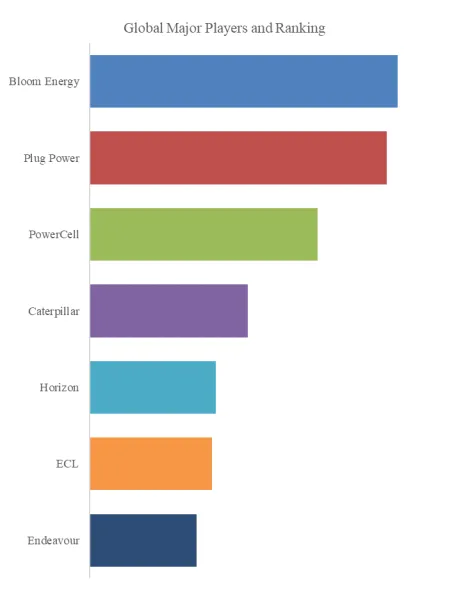
According to QYResearch Top Players Research Center, the global key manufacturers of Hydrogen Fuel Cell for Data Center include Bloom Energy, Plug Power, etc. In 2025, the global top three players had a share approximately 41.6% in terms of revenue.
Market Competition Landscape Analysis
The global Hydrogen Fuel Cell for Data Center market features a competitive landscape characterized by "U.S. technology leadership, Europe accelerating, and East Asia actively positioning."
Tier 1 (Technology Leaders with Deep Fuel Cell Expertise): This group includes Bloom Energy (global leader in solid oxide fuel cells), Plug Power (pioneer in hydrogen industry chain vertical integration), and PowerCell (representative of European high-performance fuel cell technology). These companies dominate the high-end market through core stack manufacturing capabilities, extensive megawatt-scale project experience, and deep partnerships with hyperscale data center operators.
Tier 2 (Industrial Giants with Power Equipment Heritage): Comprising Caterpillar (Caterpillar to Launch Demonstration Project Using Hydrogen Fuel Cell Technology for Backup Power at Microsoft Data Center ) and Horizon (fuel cell system integrator), these players leverage their global service networks, power system integration capabilities, and customer bases to accelerate fuel cell penetration in the data center sector through competitive replacement of traditional diesel backup power.
Tier 3 (Innovative Niche Players): Represented by ECL (a startup focused on hydrogen solutions for data centers) and Endeavour (hydrogen microgrid technology developer), these companies are emerging in specific market segments and pilot projects through innovative business models (e.g., hydrogen-as-a-service, modular leasing) and agile product iteration.
Tariff Policy and Supply Chain Restructuring
In 2025, global supply chain security reviews for hydrogen-related critical equipment and trade policy adjustments are having profound structural impacts on the Hydrogen Fuel Cell for Data Center industry:
1. Localization Requirements Reshape Industry Landscape. The U.S. Inflation Reduction Act and the EU's "Hydrogen Bank" program provide tax credits and subsidies for locally manufactured hydrogen equipment while requiring projects receiving incentives to use a certain percentage of domestically produced components. This is prompting U.S. companies like Bloom Energy and Plug Power to accelerate domestic capacity expansion, while European suppliers face increased market access barriers in North America.
2. Critical Material Supply Chain Risks Become Evident. Global supply chains for core materials such as proton exchange membranes, catalysts (platinum, iridium), and bipolar plate coatings are highly concentrated in a few countries. Geopolitical risks and export control policies could lead to supply chain disruptions. Data center operators are beginning to include "supply chain transparency" and "multi-source supply capability" as key evaluation criteria in equipment procurement.
3. Diverging Technical Standards and Certification Systems. Differences in technical standards for fuel cell grid connection, fire safety, and hydrogen storage across countries and regions increase product development and compliance costs for multinational suppliers. The International Electrotechnical Commission and regional standards organizations are accelerating the development of dedicated standards for Hydrogen Fuel Cell for Data Center.
4. Lagging Green Hydrogen Supply Infrastructure Constrains Large-Scale Adoption. Although fuel cell technology is maturing, stable green hydrogen supply, storage and transportation infrastructure, and refueling networks remain critical bottlenecks for large-scale data center deployment. Some leading data center operators are beginning to integrate upstream by building self-owned renewable hydrogen production projects to secure fuel supply.
Key Market Dynamics and Trends
Looking ahead, industry development trends will deepen along two main lines: first, the minimization of "smaller, smarter" products, such as the further popularization of peripheral implantable ports like the upper arm port, and the exploration of "smart ports" integrating wireless pressure monitoring for real-time monitoring of catheter patency; second, synergistic innovation in materials and drugs, such as developing catheters with anti-infective coatings or anti-tissue proliferation drug elution capabilities to address the two major clinical complications of catheter-related bloodstream infections and central venous catheter occlusion.
However, market development still faces significant challenges: first, increasingly stringent payer pressures, with global health insurance cost control and centralized volume-based procurement policies for medical devices continuously squeezing profit margins and forcing manufacturers to find a balance between cost control and innovation investment; second, cognitive differences and educational gaps between doctors and patients. Although the clinical benefits of implanted infusion ports are clear, in many regions, especially in primary care hospitals, doctors lack sufficient mastery of implantation techniques (especially upper arm ports), and patients have limited awareness of them, affecting the widespread accessibility of this technology.
Typical Cases and Technological Breakthroughs
The industry's focus is shifting decisively from single "fuel cell power generation efficiency improvement" to holistic optimization of "data center power-thermal-hydrogen coupling systems." A prime example is a megawatt-scale containerized hydrogen fuel cell combined heat and power system developed for hyperscale AI data centers.
Targeting the characteristics of AI clusters—high power density, significant load fluctuations, and high waste heat recovery value—this system achieves three key innovations:
Dynamic Load Following Technology: Through a hybrid architecture combining fuel cells with lithium batteries and intelligent energy management algorithms, achieves millisecond-level response speed, perfectly matching the剧烈 fluctuations of AI training loads.
Direct Utilization of High-Temperature Waste Heat: High-quality waste heat (650-850°C) generated by solid oxide fuel cells is directly converted into data center cooling energy via absorption chillers, achieving comprehensive energy efficiency exceeding 85%.
Modular Plug-and-Play Design: Integrating fuel cell modules, hydrogen storage, power electronics, and heat recovery systems into standard shipping containers, single modules achieve 1-2MW power and can be deployed within weeks, significantly shortening data center construction cycles.
This technological pathway upgrades Hydrogen Fuel Cell for Data Center from "backup power" to "zero-carbon primary power supply + efficient energy hub," representing the future direction of green data center energy infrastructure.
The report provides a detailed analysis of the market size, growth potential, and key trends for each segment. Through detailed analysis, industry players can identify profit opportunities, develop strategies for specific customer segments, and allocate resources effectively.
The Hydrogen Fuel Cell for Data Center market is segmented as below:
By Company
ECL
PowerCell
Bloom Energy
Plug Power
Endeavour
Caterpillar
Horizon
Segment by Type
Proton Exchange Membrane Fuel Cell (PEMFC)
Solid Oxide Fuel Cell (SOFC)
Phosphoric Acid Fuel Cell (PAFC)
Others
Segment by Application
High-Performance Computing
Cloud Data Centers
AI Data Centers
Others
Each chapter of the report provides detailed information for readers to further understand the Hydrogen Fuel Cell for Data Center market:
Chapter 1: Introduces the report scope of the Hydrogen Fuel Cell for Data Center report, global total market size (valve, volume and price). This chapter also provides the market dynamics, latest developments of the market, the driving factors and restrictive factors of the market, the challenges and risks faced by manufacturers in the industry, and the analysis of relevant policies in the industry. (2021-2032)
Chapter 2: Detailed analysis of Hydrogen Fuel Cell for Data Center manufacturers competitive landscape, price, sales and revenue market share, latest development plan, merger, and acquisition information, etc. (2021-2026)
Chapter 3: Provides the analysis of various Hydrogen Fuel Cell for Data Center market segments by Type, covering the market size and development potential of each market segment, to help readers find the blue ocean market in different market segments. (2021-2032)
Chapter 4: Provides the analysis of various market segments by Application, covering the market size and development potential of each market segment, to help readers find the blue ocean market in different downstream markets.(2021-2032)
Chapter 5: Sales, revenue of Hydrogen Fuel Cell for Data Center in regional level. It provides a quantitative analysis of the market size and development potential of each region and introduces the market development, future development prospects, market space, and market size of each country in the world..(2021-2032)
Chapter 6: Sales, revenue of Hydrogen Fuel Cell for Data Center in country level. It provides sigmate data by Type, and by Application for each country/region.(2021-2032)
Chapter 7: Provides profiles of key players, introducing the basic situation of the main companies in the market in detail, including product sales, revenue, price, gross margin, product introduction, recent development, etc. (2021-2026)
Chapter 8: Analysis of industrial chain, including the upstream and downstream of the industry.
Chapter 9: Conclusion.
Benefits of purchasing QYResearch report:
Competitive Analysis: QYResearch provides in-depth Hydrogen Fuel Cell for Data Center competitive analysis, including information on key company profiles, new entrants, acquisitions, mergers, large market shear, opportunities, and challenges. These analyses provide clients with a comprehensive understanding of market conditions and competitive dynamics, enabling them to develop effective market strategies and maintain their competitive edge.
Industry Analysis: QYResearch provides Hydrogen Fuel Cell for Data Center comprehensive industry data and trend analysis, including raw material analysis, market application analysis, product type analysis, market demand analysis, market supply analysis, downstream market analysis, and supply chain analysis.
and trend analysis. These analyses help clients understand the direction of industry development and make informed business decisions.
Market Size: QYResearch provides Hydrogen Fuel Cell for Data Center market size analysis, including capacity, production, sales, production value, price, cost, and profit analysis. This data helps clients understand market size and development potential, and is an important reference for business development.
Other relevant reports of QYResearch:
Global Hydrogen Fuel Cell for Data Center Market Research Report 2026
Global Hydrogen Fuel Cell for Data Center Market Outlook, In‑Depth Analysis & Forecast to 2032
Global Hydrogen Fuel Cell for Data Center Sales Market Report, Competitive Analysis and Regional Opportunities 2026-2032
About Us:
QYResearch founded in California, USA in 2007, which is a leading global market research and consulting company. Our primary business include market research reports, custom reports, commissioned research, IPO consultancy, business plans, etc. With over 19 years of experience and a dedicated research team, we are well placed to provide useful information and data for your business, and we have established offices in 7 countries (include United States, Germany, Switzerland, Japan, Korea, China and India) and business partners in over 30 countries. We have provided industrial information services to more than 60,000 companies in over the world.
Contact Us:
If you have any queries regarding this report or if you would like further information, please contact us:
QY Research Inc.
Add: 17890 Castleton Street Suite 369 City of Industry CA 91748 United States
EN: https://www.qyresearch.com
Email: global@qyresearch.com
Tel: 001-626-842-1666(US)
JP: https://www.qyresearch.co.jp
More Posts


Report This Post
Please complete the following requested information to flag this post and report abuse, or offensive content. Your report will be reviewed within 24 hours. We will take appropriate action as described in Findit terms of use.
