

Right Now

Industrial Facility Digital Twins Research:with a CAGR of 10.18% from 2026 to 2032
QY Research Inc. (Global Market Report Research Publisher) announces the release of 2025 latest report “Industrial Facility Digital Twins- Global Market Share and Ranking, Overall Sales and Demand Forecast 2026-2032”. Based on current situation and impact historical analysis (2020-2024) and forecast calculations (2026-2032), this report provides a comprehensive analysis of the global Industrial Facility Digital Twins market, including market size, share, demand, industry development status, and forecasts for the next few years.
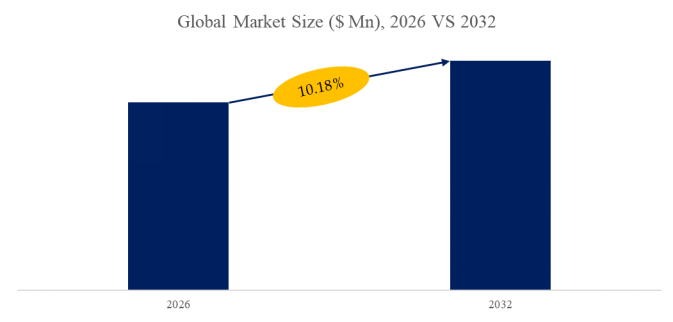
The global market for Industrial Facility Digital Twins was estimated to be worth US$ 725 million in 2025 and is projected to reach US$ 1432 million, growing at a CAGR of 10.2% from 2026 to 2032.
【Get a free sample PDF of this report (Including Full TOC, List of Tables & Figures, Chart)】
https://www.qyresearch.com/reports/6263375/industrial-facility-digital-twins
Industrial Facility Digital Twins Market Summary
Driven by the dual advancements of global industrial digital transformation and intelligent manufacturing, the industrial facility digital twin market is experiencing rapid growth. According to the latest data from QYResearch, the global market size reached $725.4 million in 2025 and is projected to climb to $1.432 billion by 2032, with a CAGR of 10.18% from 2026 to 2032. Key drivers of this growth include: global investment in intelligent industrial transformation exceeding 8%, a surge in demand for safe operation and maintenance in the energy and chemical industries, and the lowering of deployment barriers by AI and IoT technologies. Simultaneously, adjustments to global supply chains and trade policies are reshaping regional markets, with the Asia-Pacific region becoming a core growth driver thanks to China's new industrialization policies, while Europe and the US are focusing on high-end model development and standards setting. This article analyzes the technological roadmap, competitive landscape, and regional differentiation based on the global industrial landscape in 2025, providing data support for corporate strategies.
Industrial facility digital twins are a digital mirroring technology for physical factories. By constructing a high-fidelity model in virtual space that is completely identical to the physical factory, it achieves real-time mapping and closed-loop interaction between the physical and digital worlds. This system integrates IoT sensors, 3D modeling, industrial big data, and simulation algorithms to digitally reproduce all elements of the production line's operating status, equipment health, process flow, and environmental parameters. It not only possesses real-time monitoring and visual management capabilities but also predicts equipment failures and simulates process optimization schemes through mechanistic models and data analysis, feeding back optimization instructions to the physical equipment. This technology is widely used in intelligent manufacturing, energy and chemical industries, water treatment, and other fields, aiming to improve production efficiency, reduce operating costs, and ensure production safety
Figure00001. Global Industrial Facility Digital Twins Market Size (US$ Million), 2026-2032
Above data is based on report from QYResearch: Global Industrial Facility Digital Twins Market Report 2025-2032 (published in 2025). If you need the latest data, plaese contact QYResearch.
Technical Characteristics and Product Classification
Industrial facility digital twins, centered on virtual-physical mapping, real-time interaction, and intelligent optimization, achieve full lifecycle digital management of physical facilities. The technology exhibits three major trends: improved modeling accuracy, reducing multi-physics coupling simulation errors to within 1%; real-time optimization, with edge computing compressing data synchronization latency to millisecond levels; and intelligent upgrades, with AI algorithms embedded to achieve fault prediction and energy consumption optimization. Based on facility level, they are categorized into four types: component level, equipment level, production line/workshop level, and factory level, covering the entire scenario from core components to whole-plant operation. Based on technology-driven approaches, they are categorized into four types: geometric, mechanistic, data, and hybrid models. Hybrid models, balancing accuracy and adaptability, have become the mainstream approach, accounting for over 40%. By level, equipment-level digital twins account for the highest proportion at 35%, meeting the needs of single-machine operation and health management; production line/workshop level accounts for 30%, supporting production scheduling and process optimization; factory level accounts for 25%, serving whole-plant energy consumption and safety control; and component level accounts for 10%, focusing on the lifecycle management of core components of high-end equipment. By industry application, manufacturing accounts for 28%, with strong demand for optimization of automotive and 3C production lines; power and energy account for 22%, with widespread adoption of remote operation and maintenance for wind power and photovoltaic power plants; oil and gas account for 18%, ensuring the safe operation of oil and gas facilities; and chemicals, water treatment, and mining and metallurgy account for 12%, 10%, and 8% respectively, using digital means to improve compliance and efficiency.
Figure00002. Global Industrial Facility Digital Twins Top 13 players Ranking and Market Share (Ranking is based on the revenue of 2025, continually updated)
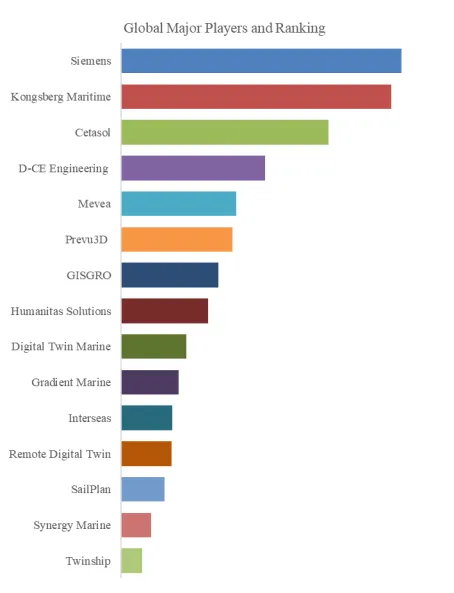
According to QYResearch Top Players Research Center, the global key manufacturers of Industrial Facility Digital Twins include Siemens, Kongsberg Maritime, Cetasol, D-CE Engineering , Mevea, etc. In 2025, the global top five players had a share approximately 40.5% in terms of revenue.
Market Competition Landscape Analysis
The global market is characterized by international giants leading the way and vertical vendors deeply cultivating their respective markets. Leading vendors include Siemens, Kongsberg Maritime, Cetasol, and D-CE Engineering, leveraging their full-stack technologies and industry experience to dominate the high-end market. The market structure is clearly tiered: the first tier, represented by Siemens, holds a 28% market share thanks to its hybrid modeling and industrial ecosystem; the second tier includes Kongsberg Maritime, Mevea, and Prevu3D, focusing on vertical sectors such as maritime and energy; and the third tier comprises regional vendors like GISGRO and Humanitas Solutions, capturing the small and medium-sized customer market with localized services. Vendors generally adopt a "model + platform + service" model, strengthening their full lifecycle delivery capabilities.
Regional Markets and Policy Drivers
Regional markets are showing clear differentiation. North America accounts for 36%, with energy and high-end manufacturing at its core, and policies driving the standardization of industrial digital twins; Europe accounts for 28%, focusing on chemical and energy security, with the EU's Industry 4.0 policy mandating the digital operation and maintenance of critical facilities; Asia Pacific accounts for 27%, with China's "14th Five-Year Plan" for intelligent manufacturing driving explosive demand, and its share is expected to exceed 35% by 2032; other regions account for 9%, seeing incremental growth due to industrial relocation. In China, relying on the "specialized, refined, and innovative" policy, domestic manufacturers are rapidly replacing imported products in the mid-range market, with solution costs 30%-40% lower than imports, promoting the widespread adoption of affordable solutions across the industry.
Typical Cases and Technological Breakthroughs
The technological approach is evolving from a single model to a hybrid-driven approach. Geometric models emphasize visualization, mechanistic models ensure accuracy, and data models rely on IoT for prediction. Hybrid models, integrating the advantages of all three, have become the mainstream. Key breakthroughs include: Siemens' factory-level hybrid twin platform, enabling full-process simulation and real-time optimization; Kongsberg Maritime's focus on marine facilities, achieving a 95% accuracy rate in fault prediction for its twin system; and Prevu3D's lightweight modeling technology reducing deployment costs.
Leading vendor case studies validate commercial value: Siemens built a twin system for a chemical industrial park, reducing energy consumption by 15% and safety incidents by 60%; Kongsberg Maritime's marine twin solution enabled remote ship diagnostics, reducing operation and maintenance costs by 25%; and Cetasol's energy twin platform helped wind farms increase power generation by 8%. A common breakthrough in the industry lies in shifting twins from a demonstration-oriented approach to an operational one, achieving a closed loop of "prediction-decision-execution," truly reducing costs and increasing efficiency.
The report provides a detailed analysis of the market size, growth potential, and key trends for each segment. Through detailed analysis, industry players can identify profit opportunities, develop strategies for specific customer segments, and allocate resources effectively.
The Industrial Facility Digital Twins market is segmented as below:
By Company
Cetasol
D -ICE Engineering
Digital Twin Marine
GISGRO
Gradient Marine
Humanitas Solutions
Interseas
Kongsberg Maritime
Mevea
Prevu3D
Remote Digital Twin
SailPlan
Siemens
Synergy Marine
TwinShip
Segment by Type
Component-Level Digital Twins
Equipment-Level Digital Twins
Production Line/Workshop-Level Digital Twins
Factory-Level Digital Twins
Segment by Application
Oil and Gas Industry
Power and Energy Industry
Chemicals
Manufacturing
Water Treatment
Mining and Metallurgy
Others
Each chapter of the report provides detailed information for readers to further understand the Industrial Facility Digital Twins market:
Chapter 1: Introduces the report scope of the Industrial Facility Digital Twins report, global total market size (valve, volume and price). This chapter also provides the market dynamics, latest developments of the market, the driving factors and restrictive factors of the market, the challenges and risks faced by manufacturers in the industry, and the analysis of relevant policies in the industry. (2021-2032)
Chapter 2: Detailed analysis of Industrial Facility Digital Twins manufacturers competitive landscape, price, sales and revenue market share, latest development plan, merger, and acquisition information, etc. (2021-2026)
Chapter 3: Provides the analysis of various Industrial Facility Digital Twins market segments by Type, covering the market size and development potential of each market segment, to help readers find the blue ocean market in different market segments. (2021-2032)
Chapter 4: Provides the analysis of various market segments by Application, covering the market size and development potential of each market segment, to help readers find the blue ocean market in different downstream markets.(2021-2032)
Chapter 5: Sales, revenue of Industrial Facility Digital Twins in regional level. It provides a quantitative analysis of the market size and development potential of each region and introduces the market development, future development prospects, market space, and market size of each country in the world..(2021-2032)
Chapter 6: Sales, revenue of Industrial Facility Digital Twins in country level. It provides sigmate data by Type, and by Application for each country/region.(2021-2032)
Chapter 7: Provides profiles of key players, introducing the basic situation of the main companies in the market in detail, including product sales, revenue, price, gross margin, product introduction, recent development, etc. (2021-2026)
Chapter 8: Analysis of industrial chain, including the upstream and downstream of the industry.
Chapter 9: Conclusion.
Benefits of purchasing QYResearch report:
Competitive Analysis: QYResearch provides in-depth Industrial Facility Digital Twins competitive analysis, including information on key company profiles, new entrants, acquisitions, mergers, large market shear, opportunities, and challenges. These analyses provide clients with a comprehensive understanding of market conditions and competitive dynamics, enabling them to develop effective market strategies and maintain their competitive edge.
Industry Analysis: QYResearch provides Industrial Facility Digital Twins comprehensive industry data and trend analysis, including raw material analysis, market application analysis, product type analysis, market demand analysis, market supply analysis, downstream market analysis, and supply chain analysis.
and trend analysis. These analyses help clients understand the direction of industry development and make informed business decisions.
Market Size: QYResearch provides Industrial Facility Digital Twins market size analysis, including capacity, production, sales, production value, price, cost, and profit analysis. This data helps clients understand market size and development potential, and is an important reference for business development.
Other relevant reports of QYResearch:
Global Industrial Facility Digital Twins Market Outlook, In‑Depth Analysis & Forecast to 2032
Global Industrial Facility Digital Twins Sales Market Report, Competitive Analysis and Regional Opportunities 2026-2032
Global Industrial Facility Digital Twins Market Research Report 2026
About Us:
QYResearch founded in California, USA in 2007, which is a leading global market research and consulting company. Our primary business include market research reports, custom reports, commissioned research, IPO consultancy, business plans, etc. With over 19 years of experience and a dedicated research team, we are well placed to provide useful information and data for your business, and we have established offices in 7 countries (include United States, Germany, Switzerland, Japan, Korea, China and India) and business partners in over 30 countries. We have provided industrial information services to more than 60,000 companies in over the world.
Contact Us:
If you have any queries regarding this report or if you would like further information, please contact us:
QY Research Inc.
Add: 17890 Castleton Street Suite 369 City of Industry CA 91748 United States
EN: https://www.qyresearch.com
Email: global@qyresearch.com
Tel: 001-626-842-1666(US)
JP: https://www.qyresearch.co.jp
More Posts


Report This Post
Please complete the following requested information to flag this post and report abuse, or offensive content. Your report will be reviewed within 24 hours. We will take appropriate action as described in Findit terms of use.
