


Right Now

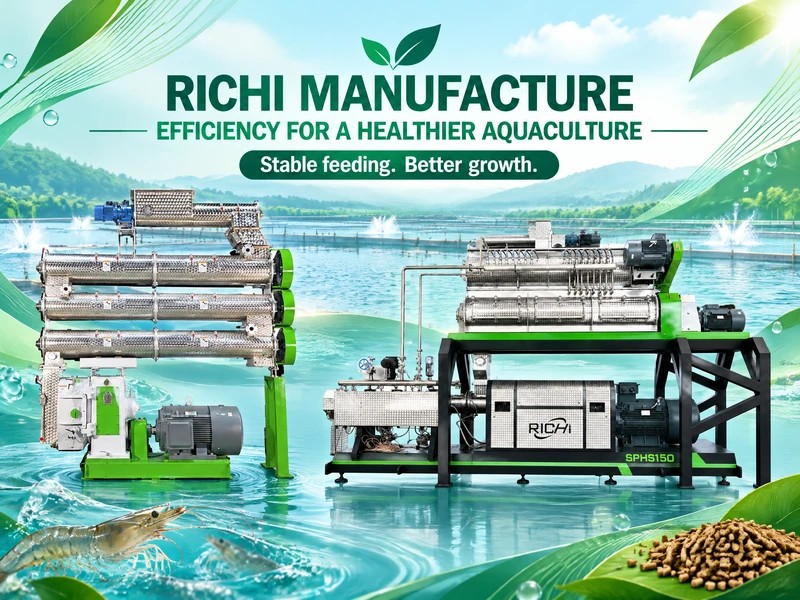
Quality Control Around an Industrial Shrimp Feed Pellet Machine
Pellet quality is not determined by the pellet mill alone. In an industrial factory, the entire process from grinding to packaging can influence the physical characteristics of the finished feed.
The industrial shrimp feed pellet machine plays the central forming role, but consistent production depends on controlling the stages surrounding it.
Particle Size
The first factor is raw material particle size.
Large variations in particle size can make mixing and pellet formation less consistent.
Fine grinding can provide a more uniform material structure for shrimp feed.
Mixing
After grinding, ingredients need to be distributed evenly.
An effective mixing process helps ensure that each portion of material reaching the pellet mill has a relatively consistent composition.
Poor mixing can create variations even if the pellet mill itself operates normally.
Conditioning
Conditioning affects the material immediately before compression.
Steam and moisture can influence temperature and material behavior.
If conditioning conditions change, pellet formation can also change.
A multi-layer conditioner provides additional processing time before the material reaches the die.
Compression
Inside the pellet mill, the rollers force the conditioned feed through the ring die.
The die determines the basic pellet diameter.
The cutter influences pellet length.
Roller condition, die condition, feeding rate, and material characteristics can all influence the compression process.
Cooling
Pellets leave the machine with elevated temperature.
They need to be cooled before further handling.
If cooling is insufficient, storage and packaging conditions may be affected.
The cooler should therefore be matched to the pellet mill's production capacity.
Screening
Screening separates finished pellets from fines and oversized material.
A properly configured screen helps maintain a consistent product size.
If excessive fines appear, operators should investigate both the pellet mill and the downstream handling process.
Monitoring in the Factory
A fish feed processing plant can establish inspection procedures for different stages.
Operators may monitor raw material particle size, mixture uniformity, conditioning conditions, pellet appearance, cooling performance, and screening results.
These checks provide information about the production process.
Handling Product Changes
When the factory changes pellet size or formula, operators may need to adjust the process.
Die specifications may need to change.
Conditioning parameters can also require adjustment.
The transition should be controlled rather than treating every product as if it required identical settings.
browse around this site for technical information when studying pellet quality and process control.
The pellet press should be evaluated together with the preparation and downstream systems.
Industrial pellet quality control is therefore a process-management task. Consistent raw materials, fine grinding, uniform mixing, controlled conditioning, appropriate die selection, stable feeding, effective cooling, and proper screening all contribute to the final product.
More Posts


Report This Post
Please complete the following requested information to flag this post and report abuse, or offensive content. Your report will be reviewed within 24 hours. We will take appropriate action as described in Findit terms of use.
